
Cluster E — Prevention · 6 min read
Spring Storm Season Tree Prep Checklist for South Texas Homes
By San Antonio Tree Care Team•Published: 2026-03-20•Updated: 2026-10-09

The South Texas Storm Calendar: Spring Supercells & Hurricane Inflow
In San Antonio and Bexar County, the storm season arrives in two distinct, violent pulses: the spring supercell season (March through June) characterized by severe thunderstorms, large hail, and destructive straight-line winds exceeding 70 mph; and the late-summer tropical season (August through October) that brings tropical depressions and torrential rainfall.
Waiting until severe weather warnings are issued to inspect your shade trees is too late. Proactive storm preparation performed during late winter and early spring identifies structural defects, relieves dangerous canopy wind resistance, and prevents multi-ton limbs from crashing onto homes and vehicles.
The 7-Point Pre-Storm Arborist Inspection Protocol
Certified arborists evaluate mature residential shade trees using a rigorous 7-point diagnostic inspection checklist before spring storms arrive:
1. Codominant Stems & Included Bark: Checking for twin trunks forming tight V-shaped unions that split under wind torque.
2. Canopy Center of Gravity & Over-Extension: Identifying heavy horizontal limbs extending over rooflines, sunrooms, or carports.
3. Basal Cavities & Decay Conks: Inspecting the lower trunk for hollows, carpenter ant frass, or bracket mushrooms indicating internal heartwood rot.
4. Root Flare Soil Heaving: Checking the windward root zone for cracked soil or raised turf indicating loosened root anchor plates.
5. Deadwood Accumulation: Mapping large dead branches (2 inches or larger in diameter) that will snap during gusts.
6. Overhead Utility Clearance: Verifying at least 10 feet of clearance from primary power wires and 3 feet from private service drops.
7. Excessive Epiphyte Biomass: Assessing heavy ball moss carpets that add thousands of pounds of water weight after downpours.
Call back within 15 minutes, on site within 2 hours inside Loop 1604
Dealing with Tree Hazards on Your Property?
Call our licensed San Antonio arborists now for 24/7 emergency dispatch or a free on-site estimate.
City of San Antonio Tree License · $1M+ General Liability · Zero Obligation Estimates
Crown Thinning vs. Lion-Tailing: Why Airflow Dynamics Matter
A dense, unpruned tree canopy acts like a massive ship sail in high wind, capturing storm energy and transferring immense rotational torque downward into the trunk and root plate. Certified crown thinning selectively removes up to 15% of secondary interior branches, opening natural wind corridors through the crown.
With properly thinned canopies, high-velocity thunderstorm winds pass smoothly through the foliage with minimal resistance, dramatically reducing wind drag. However, beware of unqualified trimmers who perform 'lion-tailing'—stripping all interior foliage and leaving tufts of leaves only at the branch tips. Lion-tailing shifts weight to the ends of branches, dramatically increasing branch breakage in storms.
Dynamic Tree Cabling & Bracing for Split-Prone Heritage Hardwoods
Many of San Antonio's most valuable heritage live oaks and cedar elms possess majestic, wide-spreading multi-stem architectures that are structurally prone to splitting under wind loads. Complete removal of these beloved historic specimen trees is rarely necessary.
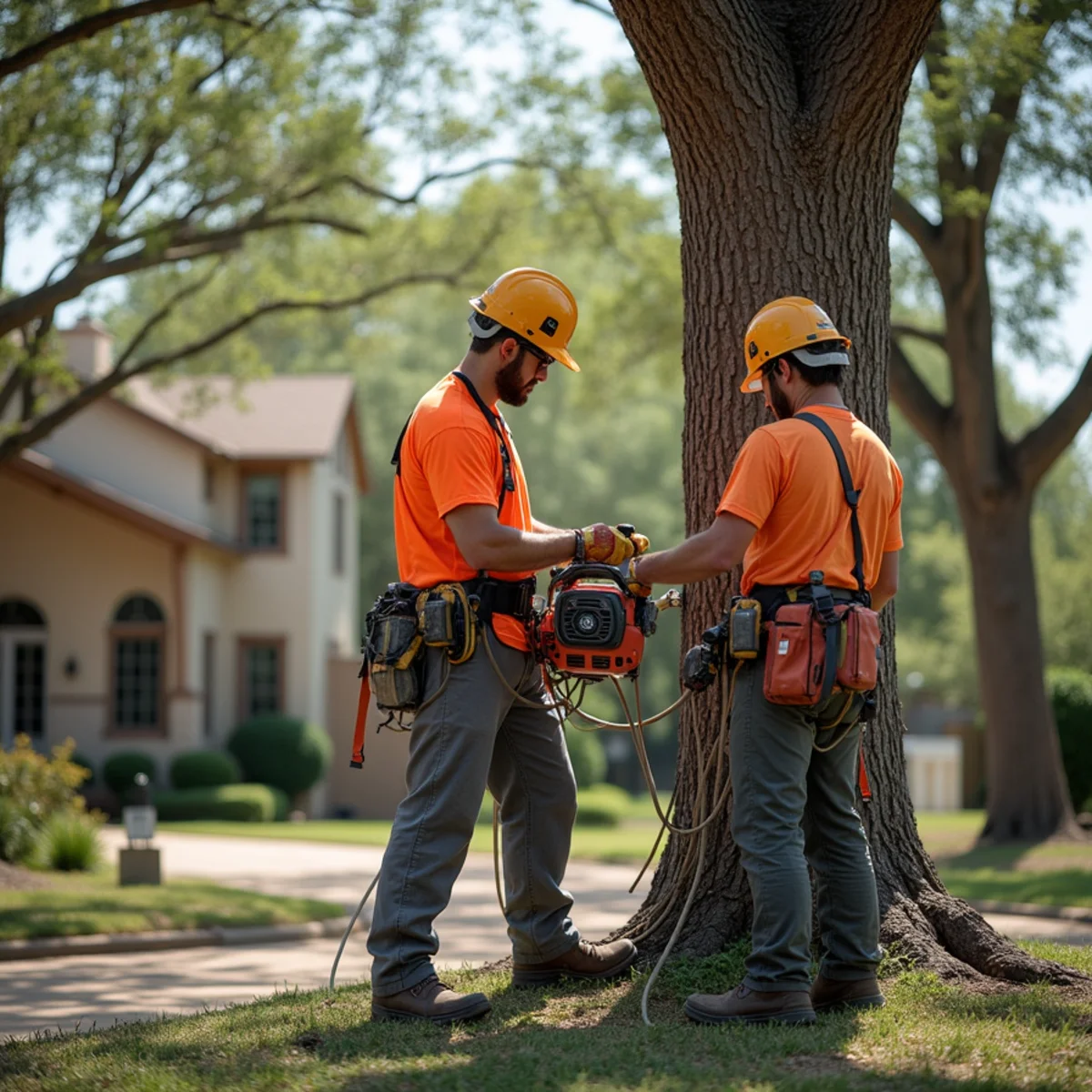
Certified arborists install dynamic cabling systems in the upper canopy. Utilizing specialized synthetic arborist ropes and shock-absorbing rubber dampeners (such as the Cobra cabling system), dynamic cables allow normal branch movement during gentle breezes but catch and support heavy limbs during violent storm gusts, preventing catastrophic codominant stem tearing without damaging wood cambium.
Roof Clearance Pruning: Protecting Shingles & Gutter Systems
Branches overhanging residential roofs present severe storm hazards. During high-wind squalls, heavy limbs whip up and down, scouring asphalt shingle granules, cracking barrel tiles, and ripping metal gutters from fascia boards. Furthermore, falling twigs and ball moss clog downspouts, causing torrential roof valley overflows that flood interior ceilings.
Our pre-storm clearance pruning elevates branches to establish an unobstructed 6-to-8-foot buffer above roof surfaces. We execute clean reduction cuts back to strong upward-growing lateral branches, preserving the natural silhouette of the tree while completely eliminating structural contact hazards.
Common Questions Related to This Guide
The ideal window for pre-storm tree pruning in San Antonio is November through January. Pruning during winter dormancy relieves canopy weight before spring storms begin and aligns with the safest period for oak wilt prevention.
Related Services & Local Coverage
Explore professional services and local neighborhoods mentioned in this guide:
Call back within 15 minutes, on site within 2 hours inside Loop 1604
Protect Your Trees & Property with San Antonio's Best
Speak with our certified arborist team today. Transparent estimates, licensed crews, and 24/7 response.
City of San Antonio Tree License · $1M+ General Liability · Zero Obligation Estimates